...

ABOUT NATIVE AMERICAN BRACELETS

The history, artistry, and heritage of traditional Southwestern silver.

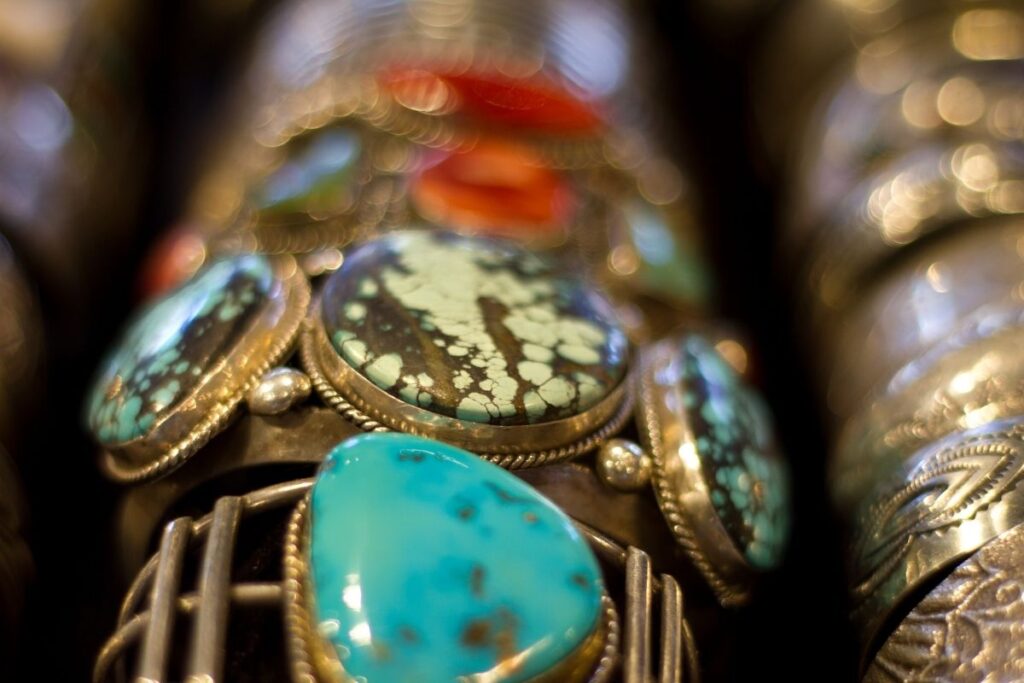
A detailed view of a heavy Navajo turquoise cluster cuff bracelet next to geometric textiles.

History & Craftsmanship

Every authentic Native American silver bracelet carries a profound lineage—a story passed from wrist to wrist, generation to generation. The legacy of Southwestern silversmithing began in the mid-19th century when Navajo artisan Atsidi Sani first mastered the forge. In those early classic periods, the craft was pure, heavy, and unadorned. Early master smiths melted United States and Mexican silver coins down into crude ingots, painstakingly pounding the dense metal into workable sheets using little more than cold chisels, rough files, and hand-carved tufa stone molds.

By the late 1870s, the art form evolved forever as pioneering silversmiths introduced hand-cut, matrix-rich turquoise settings into their silverwork. The arrival of the transcontinental railroad to places like Gallup, New Mexico, brought advanced tools, curious collectors, and a booming era of design. Plain silver bands transformed into intricate testaments of tribal identity. Navajo smiths specialized in deep, rhythmic stampwork, twisted wire details, and robust sandcast cuffs. Nearby, Zuni lapidaries mastered meticulous stone-to-stone channel inlay and breathtaking cluster work, while Hopi artisans later perfected fine, architectural silver overlay.

Since 1913, Richardson’s Trading Post has sat at the physical crossroads of this living history. For over a century, our vault has served as a trusted sanctuary for genuine wearable art, preserving direct relationships with the region’s most celebrated master smiths and multi-generational carving families. Whether you are captivated by the historic weight of a dead pawn ingot cuff or the contemporary brilliance of a hallmarked masterpiece, you are holding more than jewelry. You are participating in a century-old tradition of cultural preservation, fair trade, and unmatched American artistry. Explore our current gallery collection below, physically verified and authenticated in the heart of the Southwest.

The Richardson's Bracelet Collection

Frequently Asked Questions

Your Questions About Native American Bracelets Answered

A model wearing a striking Zuni needlepoint turquoise cuff bracelet against a white linen sleeve.

How do I know these Native American bracelets are authentic?

At Richardson Trading Post, authenticity is the cornerstone of our business, which has been family-owned since 1913. We buy directly from Native American artists, ensuring that every piece in our collection—whether it is a Navajo Sterling silver cuff or a Zuni inlay bracelet—is handmade by a member of a federally recognized tribe. This direct relationship allows us to guarantee that our jewelry complies with the Indian Arts and Crafts Act.

To find your perfect fit, use a soft measuring tape or a strip of paper to measure the circumference of your wrist just above the wrist bone. For a standard “comfort fit,” add about 1/2″ to 3/4″ to your actual wrist measurement. If you are purchasing a cuff with an inlay design, it is important to choose a size that fits well without much bending, as adjusting the metal too frequently can loosen the stones.
A hallmark is a signature stamp, usually located on the interior of the bracelet, used by Native American silversmiths to identify their work. These can range from an artist’s initials to unique tribal symbols. While older vintage pieces may not always have a mark, modern artisans use them as a symbol of pride and cultural identity. Hallmarks are a vital tool for collectors to verify the artist and the long-term value of the piece.
To preserve the natural beauty of your jewelry, avoid using liquid silver dips or harsh chemicals, which can damage porous stones like turquoise and coral. Instead, use a soft silver polishing cloth to gently buff the metal. Since turquoise can absorb oils and perfumes, we recommend putting your bracelet on after applying lotions or scents and removing it before swimming or bathing.
Sterling silver (92.5% pure silver) is the industry standard for high-quality Native American jewelry because of its durability and lustrous finish. The Navajo were the first to learn silversmithing from the Spanish in the mid-1800s, and it has since become a central medium for storytelling through intricate stampwork and engravings. Many of our pieces are stamped “Sterling” or “.925” to certify the metal’s purity.
Yes! We invite you to visit our historic location at 222 West Highway 66 in Gallup, New Mexico. Stepping into Richardson Trading Post is a visceral experience; we house one of the region’s largest collections of authentic Native American rugs, pottery, and jewelry. Visiting in person allows you to see the incredible detail of our “one-of-a-kind” pieces that are often sold before they even make it to our online store.

Recent posts

Native American Cuff Bracelet
Native American Bracelets

The Art of the Ancestors: A Guide to Native American Cuff Bracelets

Native American cuff bracelets are far more than mere accessories; they are versatile, deeply personal statements of identity and heritage. For the artisans of the Southwest, jewelry making is a sacred craft where natural materials are shaped by hand to create wearable visualizations of tribal culture. From the rugged beauty

Read More »

DISPATCHES FROM THE POST

New arrivals and stories from Gallup, delivered to your inbox.

Piece Inquiry

Please fill out the fields...