 Skip to content
At Richardson’s Trading Post, we are often asked where the story of the Southwest begins. To answer that, you have to look beyond the silver and the wool, and look instead at the stone. Before there were galleries or trading posts, the vast canyons of New Mexico and Arizona served as the world’s longest art gallery. The Native American painting art we see today is the modern chapter of a story that began over 10,000 years ago.
The First Canvases: Petroglyphs and Pictographs
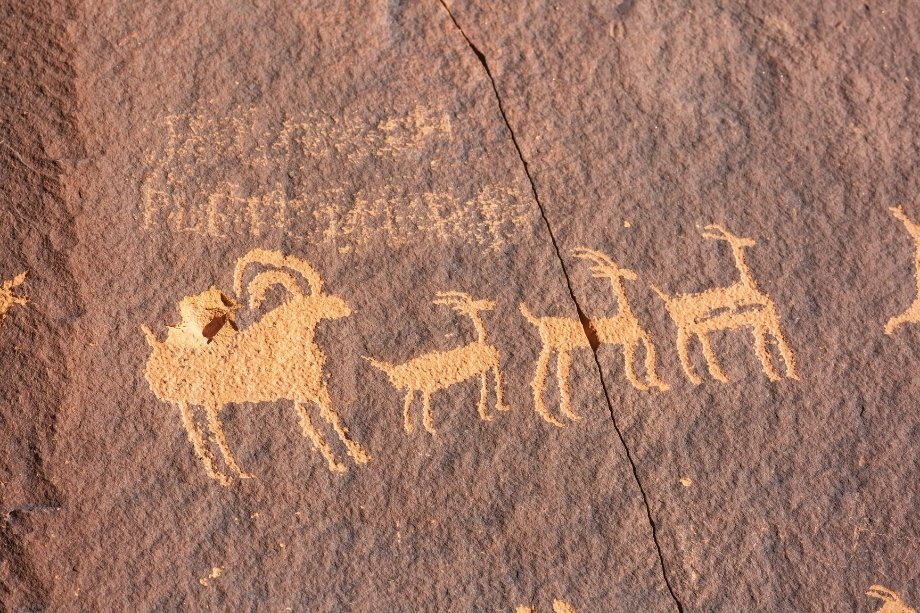
The earliest Native American art pieces were not meant to be moved; they were carved into or painted onto the earth itself. Across the Southwest, “rock art” exists in two forms: petroglyphs (images carved into the rock) and pictographs (images painted onto the rock).
Ancient Puebloans used natural minerals—hematite for red, charcoal for black, and gypsum for white—to record celestial events, migration routes, and spiritual visions. These were the first Native American drawings, and they established a visual language of symbols—the spirals, the suns, and the animal spirits—that still appear in the jewelry and pottery at Richardson’s today.
The Mural Tradition and the Kiva
As tribal groups transitioned from nomadic lives to settled villages (Pueblos), art moved from the canyon walls to the interior of their architecture. Some of the most significant historical Native American paintings were found in kivas (underground ceremonial chambers). These murals depicted rain priests, lightning, and sacred animals, serving as a spiritual technology to ensure the survival of the community in a harsh desert.
The Transition to Portable Art
By the time the first traders arrived in the 1800s, the art was evolving again. The arrival of new materials—paper, canvas, and commercial pigments—allowed artists to share their culture with the outside world. This transition gave rise to the “Studio Style” in the early 20th century, where artists began to translate traditional stories into the Native American art prints and fine art paintings that collectors recognize today.
A Legacy Preserved at Richardson’s
At Richardson’s Native American art gallery, we see ourselves as a single point on this 10,000-year timeline. When you look at a modern painting on our walls, you are seeing the same devotion to storytelling that an artist felt while standing before a canyon wall thousands of years ago.
The medium has changed from stone to canvas, but the spirit remains identical. We invite you to Gallup to explore this lineage. Whether you are interested in a piece of Native American art of the Southwest that reflects ancient symbols or a modern masterpiece, you are participating in the continuation of the oldest artistic tradition in North America.
