Skip to content
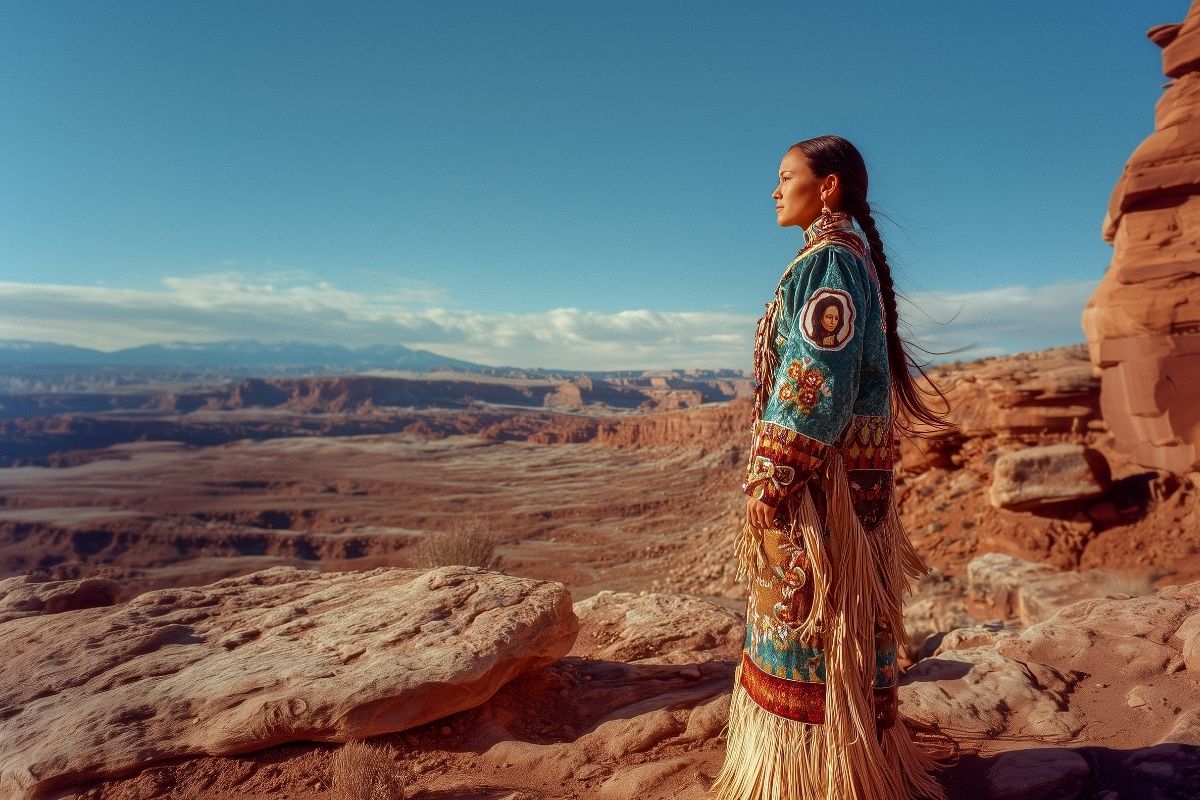
For many Native American artisans, jewelry is far more than a decorative accessory; it is a wearable archive. Specifically, in the traditions of the Navajo (Diné), Hopi, and Zuni pueblos, the storytelling bracelet serves as a profound medium for preserving history, spiritual beliefs, and the intimate relationship between humanity and the natural world.
A Language Written in Silver
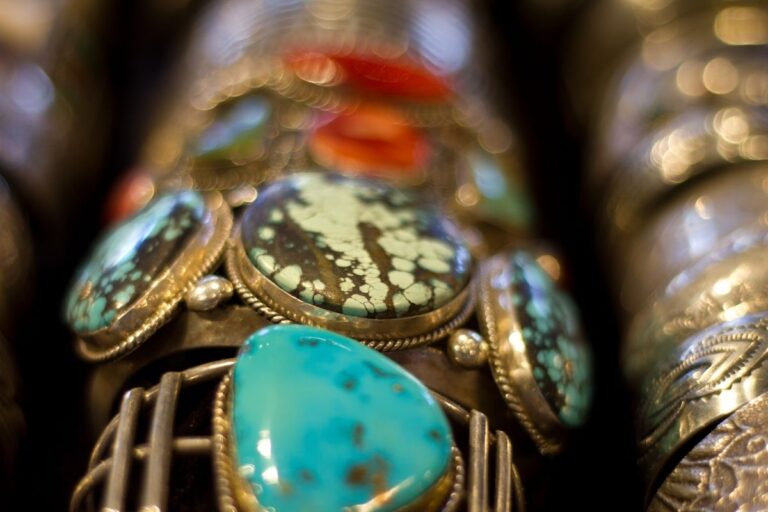
Unlike Western jewelry, which often focuses on the aesthetic sparkle of a gemstone, Native American storytelling bracelets prioritize the narrative arc. These pieces often utilize techniques like overlay—perfected by Hopi silversmiths—or tufa casting and stampwork favored by Navajo artists.
In a storytelling cuff, the silver surface acts as a canvas. A single bracelet might depict an entire migration story, the cycle of a harvest, or a sacred legend. Because these stories are often passed down orally, the jewelry serves as a mnemonic device, ensuring that the “old ways” remain visible in a modern world.
Common Symbols and Their Meanings
To “read” a storytelling bracelet, one must understand the iconography. While meanings can vary between tribes, these symbols—ranging from abstract to literal—are foundational:
- The Hogan (The Home): Represented as a domed or octagonal structure, the Hogan is the spiritual and physical center of Navajo life. It symbolizes protection, family lineage, and the sacred balance between the earth and the sky.
- The Man in the Maze: A poignant Tohono O’odham symbol representing the twists, turns, and choices of life’s journey, eventually leading to a center of peace and understanding.
- Livestock (Sheep and Goats): These silhouettes are more than just animals; they represent a family’s livelihood, wealth, and the deep connection to the land that sustained generations of weavers and silversmiths.
- The Water Emergence: Often represented by geometric waves or spirals, symbolizing the journey of ancestors from previous worlds into the current one.
- The Sunface: A Zuni deity representing life, warmth, and continuity, often rendered in intricate stone-to-stone inlay of turquoise, coral, and mother-of-pearl.
- Sacred Geography (Buttes and Mesas): Flat-topped mountain silhouettes represent the specific ancestral lands, such as Monument Valley, reminding the wearer of their roots and the permanence of the natural world.
- The Migration Motif: Depicting the movement of people across the land, often shown through stylized footprints, animal tracks, or figures walking toward a new horizon.
- Twisted Wire (The Rope Border): This common framing technique often represents the intertwining of two lives, or the dual nature of the physical and spiritual paths walking in harmony.
The Modern Legacy
Today, artists like the late Charles Loloma or contemporary masters continue to push the boundaries of this medium. They blend traditional symbols with high-fashion aesthetics, using “inner gems”—stones set on the inside of the bracelet—to represent the hidden inner beauty of the wearer.
The power of the storytelling bracelet lies in its intimacy. As the wearer moves their wrist, the story unfolds in a literal circle, mirroring the Indigenous philosophy that time and life are cyclical rather than linear. To own such a piece is not just to possess art; it is to hold a chapter of a living history.
“Our stories are not just in our books or our mouths; they are in the things we make with our hands.” — Traditional Artisan Perspective
How to Style and Collect
When looking for a storytelling piece, focus on the hallmark (the artist’s signature) and the “weight” of the story. A genuine storytelling cuff should feel substantial, both physically and culturally. These pieces pair exceptionally well with minimalist attire, allowing the complex “silver-script” of the bracelet to be the focal point of the ensemble.